
- Home
- Our Services
- Patents
Patent
LUTIN IP brings together a team of patent-information analysts with strong backgrounds in engineering, patent law, and professional patent searching. All members of our team are QPIP-certified (Qualified Patent Information Professionals), ensuring that our patent searches meet the highest international standards.
LUTIN IP brings together a team of patent-information analysts with strong backgrounds in engineering, patent law, and professional patent searching. All members of our team are QPIP-certified (Qualified Patent Information Professionals), ensuring that our patent searches meet the highest international standards.
Our QPIP analysts work closely with our patent attorneys, combining technical insight with legal expertise. This collaboration guarantees exceptional quality in both search execution and interpretation of results—an essential foundation for making informed decisions before filing a patent, launching a product, or handling intellectual property disputes.
Patentability study
The purpose of patentability studies is to check whether an invention meets the requirements for obtaining a patent. To this end, we assess the novelty and inventive step of the invention by searching our databases. The result of the study is a detailed report that usually contains a list of documents discovered during the search (e.g., patents, but often also scientific articles, publications, web pages, etc.) as well as concrete recommendations on the possibilities of protection in the different countries.
The patentability study report identifies the inventive contribution of a new product to the prior art. It thus enables the subsequent drafting of a patent application to be optimized by clearly distinguishing it from the prior art identified. In addition, protection strategies, such as the selection of the initial country or the content of claims, are tailored to these results.
Freedom to operate
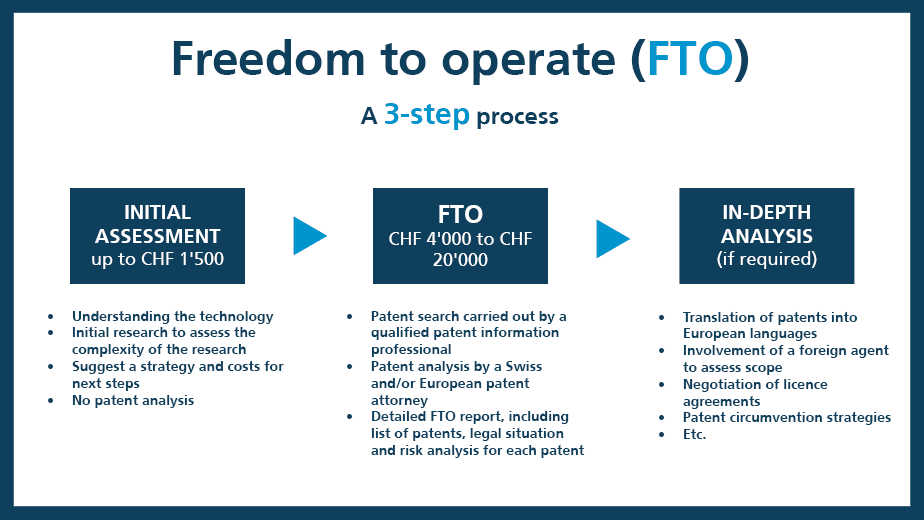
The purpose of a freedom-to-operate search is to determine whether a new product can be marketed without infringing existing patents. Often, freedom-to-operate searches are conducted before the product is fully developed, to orient the search to account for third-party patents.
Freedom-to-operate searches are generally more complex than patentability studies; for each patent discovered, it is a question of checking the claims’ content and legal status to verify their exact scope. At LUTIN IP, this work is done in close collaboration between the analyst who conducts the search and the patent attorney who interprets the patents discovered and analyzes their impact on products.
When interpreting patent claims outside Europe, we also rely on our international network of correspondents to reliably assess infringement risk. The results of a freedom to operate search consist of a list of documents accompanied by a report identifying precisely the risks involved in relation to each patent, as well as the possibilities for circumventing, attacking, or licensing these patents.
Validity search
There are three options when a third-party patent is discovered that threatens a company’s activities: acquiring a license, modifying the product to circumvent the patent, or having the patent revoked, for example, by means of opposition or invalidity proceedings. The latter solution is possible if the patent is invalid, for instance, if it lacks novelty or if the grant procedure has been marred by errors such that revocation is necessary.
We can help you revoke a patent and assist you with all the necessary steps during opposition proceedings. We usually start by completing the search conducted by the patent office that granted the patent, to check whether all relevant documents have been considered.
Thanks to our experience in the field of technology watch, we can discover prior art that calls into question the novelty or inventive step of a granted patent. We also check the entire grant procedure to find possible “latent defects” in the patent – for example, an unauthorised extension of its subject-matter after filing. We will submit the uncovered arguments to you, indicating the chances of success of an opposition procedure or an invalidity action based on these arguments.
Panoramic search
Landscape searches provide information on general patent trends in a particular field of activity. Depending on the number of patents available in the field of research, the results may include, for example, statistical indications on the evolution of the number of patents published each year, the principal applicants, the most active fields, current research trends, etc. Particularly relevant patents or representative ones are extracted to illustrate the research.
This type of research helps understand a vast field for which exhaustive research would not be feasible, or for identifying a field before defining a technology watch strategy that is repeated periodically. For subscribers to this service, the search results can be viewed through personalized access to our enobox platform.