
- Home
- Our Services
- Patents
- European Patent Application
- The Unitary Patent
The Unitary Patent
Unitary Patent – LUTIN IP Expertise (Short Version)
With a strong team of BRICS-qualified patent attorneys, LUTIN IP advises clients on the best strategy for patent protection in Europe and manages all procedures required to obtain Unitary Patents.
Our team also includes certified patent litigators authorised to represent clients before the Unified Patent Court (UPC).
Unitary Patent (Short Version)
A Unitary Patent (UP) is an option available once a European patent is granted. Instead of validating the patent separately in multiple EPC countries, the UP allows you to obtain one single patent covering participating EU Member States.
Currently, a Unitary Patent provides protection across 18 EU countries, including Germany, France, Italy, the Netherlands, Sweden, and others. More EU states are expected to join later.
Switzerland is not included because it is not an EU Member State.
With the Unitary Patent:
You request UP protection within 1 month after the EPO grant.
The patent can only be limited, transferred, revoked, or lapse as a whole.
Renewal fees are paid centrally to the EPO.
Your Options After Grant
Patent owners may choose:
Traditional validation in any of the 38 EPC countries individually.
Unitary Patent covering the 18 participating EU countries.
Unitary Patent + additional national validations in non-participating or non-EU EPC states (e.g., Spain, Poland, Switzerland, UK, Turkey).
You cannot validate both a UP and a national patent in the same participating UP country.
Translation Requirements (Transitional Period)
If the EP patent is in English → provide a translation into any other EU language.
If the EP patent is in French or German → provide an English translation.
Unified Patent Court
A new court, the Unified Patent Court (or “UPC”), will be implemented in this evolving European patent protection landscape.
UPC will be a common court for all the contracting states party to the UPC Agreement and will have exclusive competence concerning infringement actions and the validity of UPs.
Moreover, it will also have exclusive competence in respect of traditional EP patents validated in one or another contracting state(s), unless the latter are “opted out”, including EP patents that have been granted before the entry into force of the Unified Patent Court.
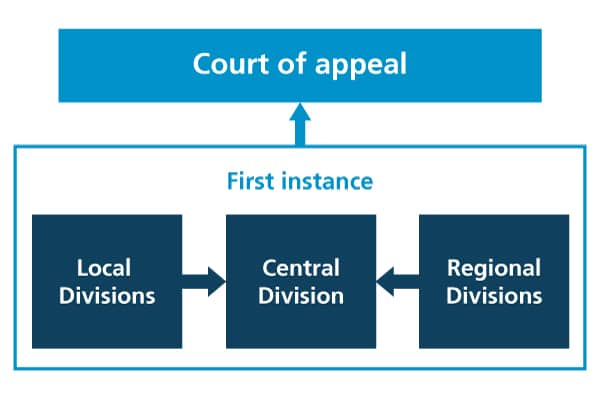
The UPC will comprise the First Instance, with a central division and various local/regional divisions located in the different Contracting EU Member State, and a Court of Appeal.
The UPC can refer questions on the interpretation of EU law to the Court of Justice of the European Union (CJEU).
Opt-out / opt-in
An opt-out request allows excluding a traditional EP patents or EP patent applications from the jurisdiction of the UPC. In this case, the competent courts remain the national courts of the countries in which the proprietor validates an EP patent.
This option is not available for Unitary Patents as the UPC holds exclusive competence for Unitary Patents.
The UPC Agreement will enter into force on the 1st day of the 4th month after the deposit of Germany’s instrument of ratification. This will define a period of at least 3 months and at most 4 months, called the “sunrise period”, before the start of this new system. It is currently expected that this entry into force will occur at the end of 2022 or the beginning of 2023.
During this period, EP patent proprietors and applicants can file early out-opt requests.
It will also be possible to request an opt-out during a transitional period of at least seven years after the start of this new system.
It is not possible to file an opt-out request if the EP patent has already been involved in proceedings before the UPC.
An opt-out request can be withdrawn at any time (opt-in) if the EP patent has not already been involved in proceedings in a national court.
Under the circumstance that a patent proprietor does not opt for any option, the national courts or the UPC inherits exclusive competency for traditional EP patents depending on the court where a plaintiff files the first action.
Other transitional measures
Possibility to request a delay in issuing a decision to grant
Upon an applicant’s request, the EPO delays issuing its decision to grant an EP patent so that the mention of the grant will be published on or immediately after the date of entry into force of the UPC Agreement.
The request is validly filed only for EP patent applications in respect of which the applicant has received a decision of grant from the EPO but has not yet approved the patent text.
This possibility ceases to have effect on the date of entry into force of the UPC Agreement.
Possibility to file early requests for unitary effect
Early requests for unitary effect will be allowed to be filed as of the date of deposit of Germany’s instrument of ratification of the UPC Agreement.
Early requests for unitary effect may only be filed for EP patent applications in respect of which a decision for grant has been dispatched.
The filing of an early request for unitary effect does not imply that the EPO will delay issuing the decision to grant a European patent.
The possibility to request a delay or to file an early request for unitary effect is only possible during the sunrise period (between 3 to 4 months before the UPC agreement enters into force).
EUROPEAN PATENT APPLICATION – UNITARY PATENT
To be recommended if:
Patent protection is desired in a considerable number of EU Member States participating in the UPC, typically more than 4.
Possibility of obtaining pan-European injunctions and damages.
To avoid if:
Patent protection is desired in few states participating in the UPC, typically less than 4.
The risk of a central revocation action before the UPC, in particular if the patent is potentially vulnerable to revocation actions.
Tight budget, especially in case of a patent dispute involving the UPC.